Developer Diary

The Full Loop

The Full Loop

  • gameplay
  • inventory
  • logistics
  • construction

What's New

We have been talking about the build loop for weeks, and now it is truly complete -- not just in the ECS plumbing, but visually. You can watch a building go up from nothing and follow every object, every tool, every log along the way.

Here is how it works. You place a barracks on a clearing. The headquarters dispatches a builder who walks out the door, follows the road network to the construction site, and waits at the flagpole. The HQ then sends an axe -- the depot settler carries it to the flagpole, a carrier picks it up, walks the winding road to the next pole, hands it off to another carrier, and so on until the axe arrives at the site. The builder picks it up, and you can see it in his hand.

Now the builder walks to the nearest tree, faces it, and swings. After a few seconds the tree topples over with a smooth rotation -- no more popping out of existence. A log appears where the tree stood. The builder stows the axe (it disappears from his hand, safely tucked away), picks up the log with both hands, and carries it back to the flagpole. He sets it down, the axe reappears in his hand, and he heads for the next tree. When all trees are cleared, he drops the axe at the flagpole -- and a carrier picks it up and walks it back to the HQ for storage.

Meanwhile, the depot settler at the headquarters has been busy too. Every time a log or a returned tool arrives at the HQ flagpole, the settler walks out, picks it up, carries it inside, and stores it. The door opens, closes, and the good vanishes into the depot. It is a small animation loop, but it makes the headquarters feel alive and purposeful.

After clearing and flattening, the builder requests a hammer and the real construction begins. Wood and stone arrive piece by piece through the carrier network, and the building rises stage by stage until it is complete. The entire chain -- from felling a tree to placing the last stone -- runs autonomously. You just watch it happen.

Behind the Scenes

The big technical change behind all of this is the new inventory system. Every settler now has an inventory with five distinct slots: right hand, left hand, a two-handed carry slot, a backpack slot (for carriers), and internal stowage for tools not currently in use.

This solved a bug that had been haunting us for days. Previously, when the builder picked up a log, the axe would simply vanish -- both items were stored in the same single field, and one overwrote the other. Now, tools and goods live in separate slots. When the builder picks up a log, the axe is automatically stowed (invisible but tracked), and when he drops the log, the axe comes back out. The visual system reads the inventory directly every frame, so there are no more phantom items lingering at flagpoles.

We also removed over 1,600 lines of old code this week -- four entire systems that had been replaced by our data-driven FSM architecture. The codebase is getting leaner, and bugs have fewer places to hide.

What's Next

The construction loop is solid. Next we are turning our attention to production chains: woodcutter lodges, farms, and mines. Once goods flow not just to construction sites but between workshops, the settlement will truly sustain itself.

Settlers on the Move

Settlers on the Move

  • gameplay
  • logistics
  • settlers
  • transport

What's New

This is the update we have been building toward for weeks. The settlers of Novus Terminus: First Flags are no longer just standing around looking pretty -- they are working. Really working. And you can watch every step of it.

Place a building in your settlement and the whole machinery kicks into motion. A builder walks out of the headquarters, picks up an axe from the flagpole, and heads to the construction site. Trees in the way? The builder chops them down -- and you can actually watch the tree topple over with a satisfying fall animation. Each felled tree produces a log that appears right there on the ground. The builder picks it up, carries it to the nearest flagpole, and sets it down. Now the carriers take over.

Carriers are the lifeblood of your road network. Each one is assigned to a stretch of road between two flagpoles, and they spend their day picking up goods at one end and walking them to the other. Watch a log travel from the forest clearing to the headquarters: a carrier hoists it onto their back with a loading animation, walks the winding road to the next flagpole, sets it down, and another carrier picks it up for the next leg. The goods physically move through your network, pole by pole, until they arrive at their destination. At the headquarters, a depot settler walks out, collects the delivered goods from the flagpole, carries them back inside, and the door closes behind them.

What makes this so satisfying is that every piece of it is visible and connected. There are no invisible teleportations, no abstract progress bars. If you place your roads poorly, you will see carriers waiting around with nothing to do while goods pile up at a distant flagpole. If you build an efficient network, you will see the smooth flow of materials rippling through your settlement like a well-oiled machine.

The whole construction loop now works from start to finish: the building requests the tools and materials it needs, the headquarters dispatches them, carriers transport everything through the road network, and the builder assembles the structure piece by piece. It is still early days, but the core promise of the game -- build a settlement, design your logistics, and watch it all come to life -- is right there on screen.

Behind the Scenes

One of the trickier problems we solved this week was making sure carriers navigate the roads naturally. Our roads are not straight lines -- they curve and wind across the terrain like real footpaths. Carriers now follow these winding paths precisely, leaning into curves with smooth look-ahead turning. We also made sure that when a carrier is already standing on their assigned road, they take a shortcut instead of walking all the way back to a flagpole first. Small detail, but it makes the whole thing look much more natural.

We also did a big spring cleaning of the codebase, removing over 1,600 lines of old code that had been replaced by our new systems. The game is getting leaner and more robust with every update.

What's Next

The transport chain is flowing, buildings go up, and the settlers are busy. Next on the agenda: getting the first production chains running -- woodcutter, food, mining -- so your settlement can truly sustain itself.

From Prototype to Product

From Prototype to Product

  • gameplay
  • design
  • visuals
  • clans

What's New

Something clicked this week. After months of building terrain, animals, shaders, and animation systems, we stepped back and asked ourselves: what is this game really about? The answer came clearly, and it shaped everything that followed.

Novus Terminus: First Flags is not just another city builder. It is a logistics puzzle wrapped in a cosy, living world. The heart of the game is what we call "System Bustle" -- every good in your settlement exists as a physical object. When a woodcutter fells a tree, the log appears on the ground. A carrier picks it up, hoists it onto their back, and walks it down the road to the next flagpole. Another carrier takes it from there to the sawmill. You can watch the entire journey, and if something goes wrong -- a road is too long, a junction is clogged, a storehouse is full -- you can see the problem. Carriers wait impatiently at crowded flagpoles. Exhausted workers slow down and eventually collapse. The jam is visible, and solving it is the puzzle.

This is what sets us apart from other games in the genre. Some city builders treat logistics as an invisible background system. Others give you settlers that bustle around as eye candy but have no real connection to what is happening underneath. In Novus Terminus, what you see is what is actually happening. You are the engineer of your own transport network, and every decision you make -- where to place a road, which junction to upgrade, what to prioritise -- has visible, tangible consequences.

We also finalised the design for the game's three clans, and they are not just cosmetic reskins. Each one plays fundamentally differently:

  • The Iron Clan -- Versatile and balanced. They have access to the widest range of military units, including mounted knights, and their economy can adapt to almost any situation. A solid choice for players who like flexibility.
  • The Wood Clan -- Masters of endurance and patience. Their workers tire 50% slower than other clans, their warriors fight with a samurai-inspired dual-strike style, and they gain bonuses when fighting in forests. Perfect for players who like to build deep, efficient networks and outlast their opponents.
  • The Stone Clan -- The fortress builders. Their defensive structures are twice as strong, their legionnaires wear heavy bronze armour, and their stone walls are nearly impenetrable. Ideal for players who want to build an unbreakable domain and expand methodically.

The interplay between clans creates a natural rock-paper-scissors dynamic: Iron's direct assault overwhelms Wood, Wood's attrition grinds down Stone, and Stone's fortifications hold against Iron. But crucially, this asymmetry comes from how each clan's economy works, not from arbitrary combat bonuses. A Wood Clan player wins by building a logistics network so efficient that their slower army simply never runs out of supplies.

Behind the Scenes

This week also brought a major visual upgrade. We completely rebuilt the cloud system -- they now have rounded, three-dimensional shapes with sunlit tops and shadowed undersides, and their shadows fall correctly on both the terrain and the ocean. We fixed a long-standing lighting bug where the sun was accidentally shining upward (which explained a lot of eerie atmosphere in earlier screenshots), and we added proper aerial perspective fog that blends the ocean horizon into the sky. The whole game now has that warm, golden-hour glow we have been chasing since the beginning.

On the gameplay side, the first interactive loop is working. You can place flagpoles, connect them with roads, open the building catalogue to browse 30 buildings with 3D previews, place buildings on the terrain, and watch carriers deploy to walk the roads between them. Cut a road and the carrier reroutes in real time. It is still early, but the feeling of watching your little settlement hum with activity is already there.

What's Next

Carriers are walking, buildings are placed, but the real magic happens when goods start flowing. Next up: the full transport chain, from tree to sawmill to construction site.

The World Comes Alive

The World Comes Alive

  • integration
  • milestone

What's New

When we first started building the world of Novus Terminus: First Flags, everything was made of simple placeholder shapes -- blocky trees, flat ground, and not much else. Over the past weeks, all of that has changed. The world has come alive.

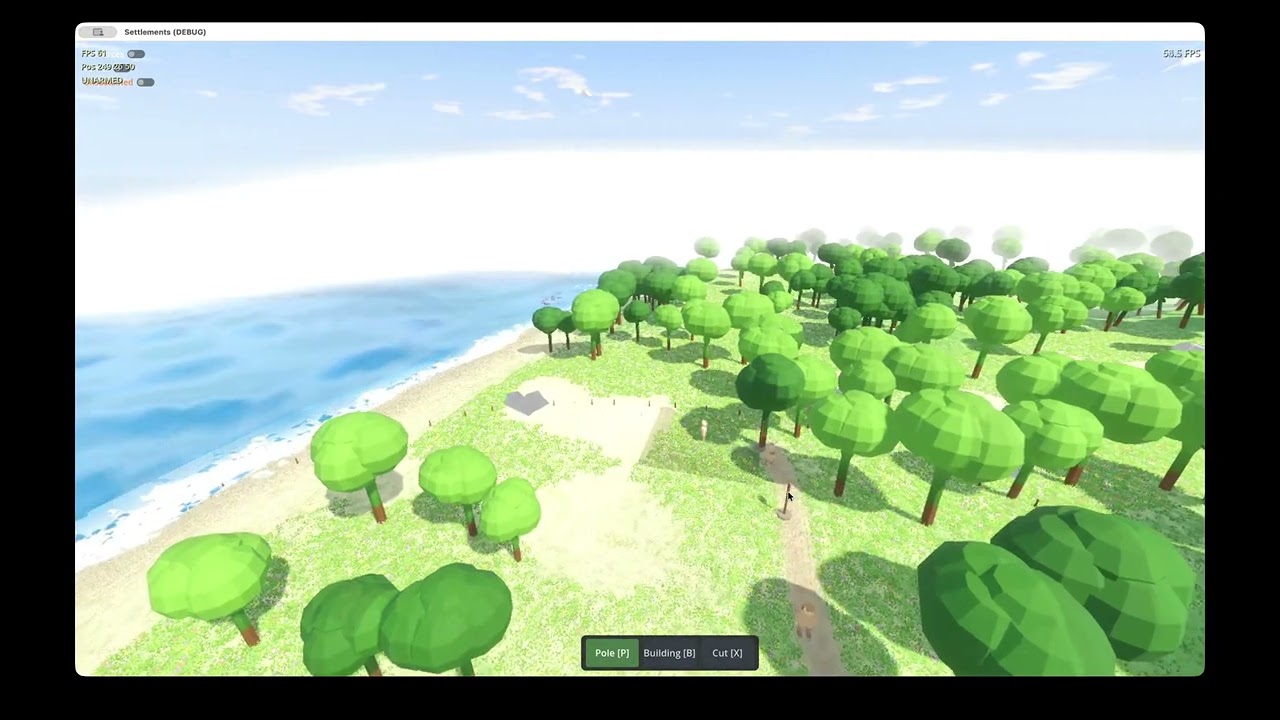
Stand on a hilltop now and look around: rolling meadows stretch out below you, covered in swaying grass and scattered wildflowers. Forests of deciduous trees fill the lowlands, their canopies gently rocking in the wind, while dark conifers climb the mountain slopes. Down at the coast, ocean waves lap against the shore with white foam dissolving into organic patches on the sand. Fluffy cumulus clouds drift overhead, casting soft shadows that glide across the terrain and darken the water beneath them.

But the landscape is not just scenery -- it is inhabited. Herds of deer graze on the meadows. Watch them long enough and you will see a doe lift her head in alert, ears twitching, before the herd moves on. Fawns stay close to their mothers, noticeably smaller and lighter in colour. Schools of fish circle near the coast, each one weaving independently through the water. And above it all, ravens soar in wide circles before swooping down to peck at the ground, then launching back into the sky.

We have integrated over 108 unique 3D assets into the game -- 33 buildings, 30 different settler types each with 20 animations, three animal species, and multiple tree varieties. Every single one of these was modelled in our custom pipeline and brought into the engine with proper animations. The settlers themselves can walk, carry goods, sit down to rest, eat, lie down to sleep, build with hammers and saws, and much more. When the game starts and you watch your first settlers file out of the headquarters one by one, the door swinging open and shut for each of them, it finally feels like a living place.

Behind the Scenes

Getting all of this to run smoothly was a real challenge. The world has around 5,000 trees, over six million individual grass blades, nearly 150 deer across 30 herds, 25 fish schools, and 15 ravens -- all animated, all casting shadows, all swaying or moving independently. We spent a lot of time making sure the wind affects only the treetops while the trunks stay rigid, and that every animal transitions naturally between behaviours like grazing, walking, and being startled.

One thing we are especially proud of: the clouds are not flat textures. They have actual rounded shapes with bright sunlit tops and darker undersides, and the shadows they cast on both the land and the ocean are perfectly synchronised. It is a small detail, but it makes the whole atmosphere feel cohesive and warm -- exactly the cosy feeling we are going for.

What's Next

With the world looking and feeling alive, it is time to let the player shape it. Next up: placing buildings, connecting roads, and watching your settlers get to work.

The Building Pipeline

The Building Pipeline

  • buildings
  • pipeline

What's New

A settlement game lives and dies by its buildings. This week, we're pulling back the curtain on how the buildings of Novus Terminus: First Flags come to life -- from the very first sketch to a fully animated structure your settlers can call home. And we've got a lot of them: 32 unique buildings for the Iron Clan alone, spanning homes, workshops, mines, military outposts, and civic centres.

Every building in the game follows the same journey. It starts as a design concept tied to a specific role in the production chain -- a butcher needs a chopping block and meat rack, a baker needs an oven, a pig farm needs a muddy pen with a shelter. From there, each building is modelled as a 3D object, rendered from four angles (front, side, top, and a classic isometric view) for our internal reference catalogue, and then imported into the game engine where it becomes a living, interactive part of the world.

What makes these buildings special is how they're constructed in-game. When your settlers start building, they don't just plop down a finished structure. You watch the construction unfold stage by stage: first the stone foundation goes in, then the timber frame rises, the roof goes on, walls fill in between the beams, and finally the finishing touches appear -- glass windows, iron-banded doors, decorative shutters. A simple dwelling might go through four stages; the grand fortress takes seven, starting from a massive stone platform and ending with corner towers, a portcullis, and battlements. Each stage is a visible, satisfying milestone.

The military buildings received special attention during this pass. The watchtower now features proper half-timbered construction on its base with elegant diagonal braces, while its upper tower has arrow slits and a pyramid roof crowned with a flag. The fortress is a proper medieval stronghold -- a central keep surrounded by four corner towers and curtain walls, with a double gate that swings open on both sides. Even the humble barracks got a complete rethink: it's now a rough-hewn wood plank hut with a lean-to roof, a weapon rack with three spears propped against the wall, and board gaps that follow the roof slope for an authentically rustic look.

Once a building is finished and occupied, it comes alive with small animations. Doors swing open when settlers arrive and close behind them. Chimneys send up wisps of smoke when someone is home. Flags flutter atop watchtowers and fortresses. These details are small individually, but together they make the difference between a static diorama and a settlement that feels like it's bustling with activity.

We also completed several new production chain buildings this round: the butcher's workshop (with its chopping block and hanging meat rack), the armoury (forge, anvil, and weapon rack), and the pig farm (a fenced pen with a lean-to shelter). Alongside the buildings, new settler types, tools, and even animals were added -- including a raven that will eventually circle over the meadows as ambient wildlife.

Behind the Scenes

One of the interesting challenges with 32+ buildings is maintaining visual consistency. We developed a standard quality checklist that every building must pass: logical build stages, proper wall panels around window and door openings (instead of solid blocks), correct door pivot points for animations, chimney positions for smoke effects, and clean integration of decorative elements like flags and weapon racks. Several buildings went through multiple complete rewrites to meet this bar -- the guard house, fortress, and barracks were all rebuilt from scratch. The design process also fed back into our game design document: modelling the buildings revealed gaps in the production chains, leading us to add new roles (like the cook) and remove others that didn't work (the shipyard was cut, with boat production moved to the sawmill).

What's Next

32 buildings down, two more clans to go. The Iron Clan's settlement is taking shape -- next we'll be putting settlers to work inside these buildings and watching the production chains come alive.

Every Good Has a Home

Every Good Has a Home

  • resources
  • phase-3

What's New

A settlement needs more than pretty scenery -- it needs stuff. Wood, stone, iron, coal, gold, fish, and game: this week we filled the island with all the raw materials your settlers will depend on, and we made every one of them visible, harvestable, and alive.

Start near the mountains and you'll spot clusters of angular boulders hugging the hillsides -- stone quarries, their rough-cut rocks catching the light. As your settlers chip away at them, the boulders physically shrink and some disappear entirely, leaving behind smaller rubble. It's a satisfying visual feedback loop: you can glance at a quarry from across the map and immediately tell how much stone is left without opening any menus. Deep inside the mountains, veins of iron, coal, and gold wait to be tapped -- these are hidden resources that won't reveal themselves until you send miners to claim them.

Down at the coast, silver fish dart in lazy circles just offshore. Each school is a little cluster of a dozen fish orbiting and weaving around each other with a natural, slightly unpredictable movement. Overfish a school and the numbers visibly thin out; leave it alone and the population slowly recovers. Sustainability matters here.

Inland, herds of roe deer roam the meadows and forest edges. Young fawns are light tan; as they age, their coats darken to a rich chocolate brown. The deer graze, reproduce when conditions are good, and grow old. When a deer reaches the end of its life, it quietly walks toward the nearest tree and disappears -- no dramatic death animation, just a gentle, dignified exit. But here's where it gets interesting: the deer and the forest are connected. If you clear-cut the trees around a herd, their habitat degrades. Reproduction slows, then stops, and eventually the deer begin to leave. Let the forest recover and the wildlife returns. It's a small but meaningful ecological loop that rewards sustainable play.

The forests themselves are no longer just scenery either. Trees can now be felled -- and when they are, they topple over with a satisfying falling animation, lie on the ground as logs, and eventually regrow as tiny saplings that slowly reach full size. Deforest an area too aggressively and the zone becomes barren, unable to regenerate. But practice careful forestry and the woods sustain themselves indefinitely.

Behind the Scenes

Getting the ecosystem to feel right meant connecting a lot of moving parts. The island is divided into hundreds of local zones, each tracking how many trees are standing versus felled. Zone health determines whether saplings can regrow and whether deer can reproduce -- creating a web of cause and effect that plays out naturally without the player needing to manage it directly. We also added a debug overlay for development that projects every resource deposit onto the screen with colour-coded icons -- invaluable for balancing placement density during testing, even if players will never see it.

What's Next

The raw materials are in place and the ecosystem is breathing. Next, we need buildings and settlers who know what to do with all of it -- time to build the production chains.

Trees in the Wind

Trees in the Wind

  • trees
  • phase-3

What's New

When we first dropped our little settlers onto the island, something felt off. The terrain was there -- rolling meadows, rugged mountains, sandy beaches -- but it all looked a bit... naked. This week, we finally gave the world its forests, and the difference is night and day.

Novus Terminus: First Flags now features two distinct tree types that populate the landscape based on the biome they grow in. Down in the lowlands and across the dense forest regions, you'll find broad-canopied deciduous trees with lush, rounded crowns. Venture higher toward the mountain ridges, and the vegetation shifts to tall, narrow conifers -- stacked layers of dark green needles standing in tight formation against the rock. The forests aren't just wallpaper, either. Each biome has its own density: deep woodlands are thick with trees, meadows have the occasional solitary oak dotting the grassland, and the lower mountain slopes carry scattered pines where the altitude allows it. The result is an island that feels like a real place, with natural transitions between open fields and dense woodland.

But the real magic happens when you just... stop and watch. Every tree on the map sways gently in the wind. The broad deciduous canopies rock and sway with big, lazy movements, while the stiff conifers barely nod -- exactly the way you'd expect a pine to behave compared to a birch. No two trees move in perfect sync; each one has its own subtle rhythm, so a hillside of trees ripples like a green ocean rather than swaying like a chorus line. Look closely and you'll notice the trunks stay nearly rigid while the treetops do all the dancing. Pull the camera back and the distant treeline comes alive with gentle, exaggerated motion on the horizon -- a small touch that makes the world feel vast and breathing.

All told, the island is now home to around 40,000 trees. Standing on a hilltop and looking out across the map, you can trace the biome boundaries just by following the treeline: round canopies giving way to pointed silhouettes as the land rises. It's one of those features that doesn't change how you play -- but it completely changes how the game feels.

Behind the Scenes

Generating that many trees by hand would be impossible, so every single tree on the map is procedurally created -- the game builds the geometry itself at startup, then scatters thousands of instances across the terrain in under a second. Each tree is placed precisely on the ground surface rather than hovering or clipping through hills, which is one of those invisible details you only notice when it's done wrong. Getting the wind animation to look natural took some iteration: early versions had trunks bending like rubber, so we settled on a physics-inspired curve that keeps the base stiff and lets only the upper canopy move freely.

What's Next

The trees are standing tall -- but they won't stay untouched forever. Next up, we're giving these forests a purpose: resources, harvesting, and the first signs of a living ecosystem.

Wildflowers & a Farewell

Wildflowers & a Farewell

  • vegetation
  • design
  • phase-2

What's New

Today's update brings colour to the meadows of Novus Terminus: First Flags -- and says goodbye to a feature that was never meant to be.

Meadows are blooming. Scattered across the grasslands you will now find clusters of wildflowers: red poppies, golden buttercups, purple cornflowers, and white daisies. They appear in small natural patches rather than an even sprinkle, so some corners of a meadow might be dotted with yellow while another stretch shows a mix of red and purple. The flowers only grow in open meadow -- step into a forest and the undergrowth stays purely green. As you pull the camera back, the flowers fade along with the grass, so there is no jarring colour pop at the horizon. It is a subtle addition, but it transforms flat green fields into something that feels genuinely pastoral.

A farewell to desert shimmer. We had originally planned to add heat shimmer and tumbleweeds to the desert biome -- that wavy, distorted-air look you see in movies, plus rolling bundles of dried brush. We built prototypes of both, and... they were completely invisible. The problem is one of scale: heat shimmer is a close-up phenomenon. From the strategic camera height where you actually play the game, the distortion is smaller than a single pixel. We tried cranking the effect strength until it was visible, but then it just looked like a broken colour overlay rather than shimmering air. Tumbleweeds had the same issue -- at realistic sizes, they were tiny specks lost against the sand.

So we made the call: cut both effects and move on. The desert already has its warm sand tones and scattered sandstone pebbles, which read clearly from any camera height. Sometimes the best visual effect is the one you do not add. We would rather spend that time on features you can actually see and enjoy.

Behind the Scenes

The wildflowers are one of those satisfying tricks where we got a big visual payoff for almost no performance cost. Instead of placing thousands of tiny flower models as separate objects, we colour the tips of existing grass blades. About eight percent of blades in meadow areas get a coloured tip, chosen from four species based on their position in the world. Because the colours are clustered spatially rather than scattered randomly, you get natural-looking patches. The whole system adds essentially zero overhead -- no extra geometry, no extra draw calls, just a touch of colour math on blades that were already being drawn.

What's Next

With the terrain, ocean, grass, and flowers in place, the visual foundation of the world is complete. Next up: we turn our attention back to gameplay -- buildings, settlers, and the logistics chains that bring it all together.

Coast, Waves & Grasslands

Coast, Waves & Grasslands

  • ocean
  • grass
  • phase-2

What's New

Three big leaps for the landscape of Novus Terminus: First Flags today: the terrain now flows naturally between biomes, the ocean looks and moves like a real body of water, and the grass system has been supercharged to cover the entire map at seven million blades.

No more cliff faces between biomes. Previously, grassland could slam straight into a mountainside with a near-vertical wall. Now there is a smooth progression: flat meadows roll into gentle foothills, which rise into a rocky alpine shoulder before the mountain walls begin. The map has also doubled in size to give everything room to breathe -- more space for your settlements, more coastline to explore, more forested valleys to expand into. Grass now respects the slope of the terrain, too: it grows on gentle hillsides but stops where the ground gets too steep, so you never see blades poking sideways out of a cliff.

The ocean is alive. Waves roll in with varied height and direction -- broad swells from the open sea layered with smaller cross-chop and ripples that make the surface feel organic rather than tiled. When sunlight passes through a wave crest, you can see a subtle turquoise glow from the inside. At the shoreline, white foam builds up where the water meets the land, and a rhythmic swash of surf advances and retreats across the beach. Look closely and you will notice that the sand itself changes: the strip closest to the water darkens and turns glossy as each wave washes over it, then slowly dries between swells. It is a small detail, but it makes the coast feel genuinely alive.

Seven million blades of grass. We rebuilt the grass system from the ground up with a new approach that renders bushels of blades rather than individual ones. The wind now flows consistently across the entire world -- the same breeze that pushes the ocean waves also sways the grasslands, which gives the landscape a wonderful sense of unity. Grass fades smoothly into the distance over about a hundred metres, so there is never a visible pop-in boundary. Forest areas get a darker shade of green to distinguish them from open meadow.

Behind the Scenes

The ocean uses a wave model called Gerstner waves -- the same maths behind many AAA ocean systems, but we kept things lean with five carefully tuned wave layers instead of a full simulation. To prevent the waves from looking repetitive, each layer gets a subtle random time offset that keeps the pattern from ever quite repeating. The wet sand effect reuses the same oscillation formula as the surf, so the darkening stays perfectly in sync with the approaching water. On the grass side, the big performance win came from a biome texture that tells the grass where it is allowed to grow. Blades that land on desert, water, or mountain tiles simply vanish before they are ever drawn, so we do not waste a single frame on invisible grass.

What's Next

Wildflowers are sprouting in the meadows -- expect poppies, buttercups, and more colour in the fields very soon.

A New Perspective -- and Three Million Blades of Grass

A New Perspective -- and Three Million Blades of Grass

  • camera
  • grass
  • phase-2

What's New

We completely rebuilt how you see the world in Novus Terminus: First Flags -- and then we filled that world with grass.

The camera now follows you, not the other way around. The old camera felt disconnected -- zooming meant fiddling with distance-to-focus, and rotating always seemed to move the wrong thing. The new system works the way your brain expects: press forward to go forward, scroll to see more or less of the map, and drag to look around. When you're zoomed in close, the camera tilts to a near-ground perspective so you can watch your settlers walk past. Pull back, and it smoothly transitions to a bird's-eye strategic view where you can plan your next expansion. There's no manual pitch or zoom slider to manage -- the camera just does what feels right based on how high above the terrain you are. Edge panning, smooth momentum, terrain-aware clamping so you never clip through a hillside -- it all just works.

Then there's the grass. We wanted meadows that feel alive, not painted-on textures. The result is roughly three million individual grass blades swaying in the wind across every meadow and forest on the map. Each blade catches the light differently -- darker at the roots where sunlight doesn't reach, brighter at the tips. A gentle breeze ripples through the field, and because the wind phase shifts across the landscape, you see rolling waves of motion rather than everything swaying in lockstep. Up close, it looks dense and lush. Pull the camera back, and the grass gracefully fades into the terrain colour, so there's never a harsh pop-in line at the horizon.

The difference is dramatic. Where the map used to be flat painted tiles with a few placeholder cones, it now feels like a living landscape. Meadows have depth and texture. Forests have a dark carpet of undergrowth. And all of it runs at a smooth 60 FPS.

Behind the Scenes

Getting three million blades of grass to run at 60 FPS was not our first attempt. We tried several approaches -- one looked like green worms, another brought the frame rate down to single digits. The breakthrough came from splitting the map into hundreds of small chunks, so the engine only has to draw the grass you can actually see. Blades in the distance gradually shrink to nothing before their chunk switches off entirely, creating a seamless fade that's invisible in practice. Shadows are disabled on grass (you'd never notice them from above), and we avoided any expensive transparency tricks that would slow things down.

What's Next

Smooth terrain transitions between biomes and a proper ocean are on the workbench -- coastlines are about to get a lot more interesting.